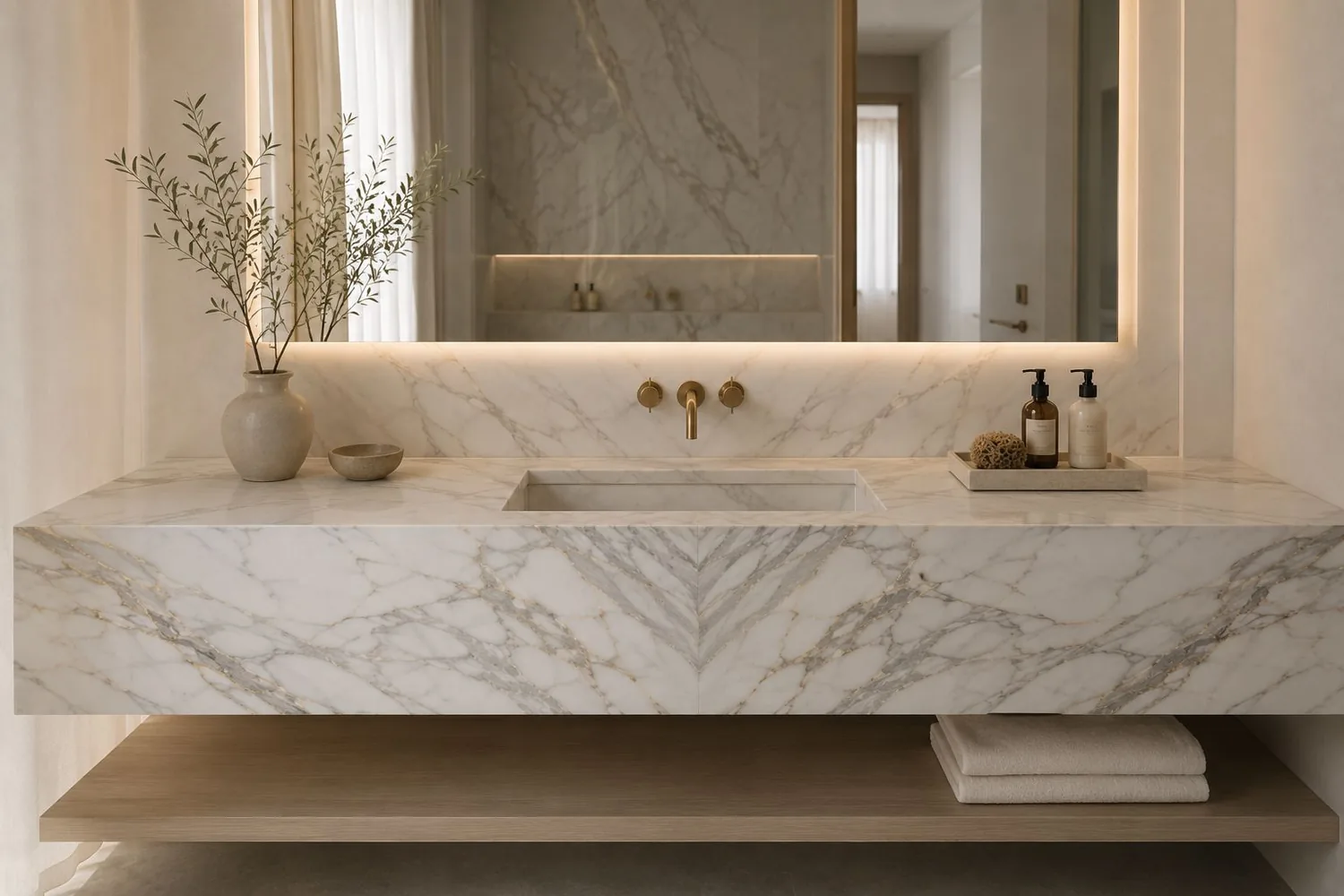
Walk through any slab yard and you'll see white stones with sweeping gray veins labeled both marble and quartzite. They can look almost identical — but they live very differently in a kitchen. Here's what sets them apart.
Where they come from
Marble is a metamorphic rock formed from limestone. Its main mineral, calcite, gives it that soft, luminous look — and also makes it sensitive to acids.
Quartzite is a metamorphic rock formed from quartz-rich sandstone. Heat and pressure fuse the quartz grains together, producing a very hard, dense natural stone that can carry the same flowing veins people love in marble.
The practical differences
| Marble | Quartzite | |
|---|---|---|
| Hardness | Softer — can scratch | Very hard — resists scratches |
| Acids (lemon, wine, vinegar) | Etches (dull marks) | True quartzite does not etch |
| Sealing | Recommended | Recommended |
| Look over time | Develops a soft patina | Stays closer to day one |
| Best for | Baths, baking stations, people who love patina | Busy kitchens wanting a marble look |
Watch out for "soft quartzite"
Not every slab sold as quartzite behaves like one. Some stones in the trade are actually marbles or dolomites with a quartzite-style name. They're beautiful, but they'll etch and scratch more like marble. That's why we always recommend testing a sample before you decide.
Two simple tests
- The glass test. Drag a sharp corner of a glass tile firmly across a sample edge. True quartzite is harder than glass and will scratch the glass instead of the other way around. Marble will be scratched.
- The etch test. Put a few drops of lemon juice or vinegar on a sample, wait 10–15 minutes and wipe it off. If you see a dull spot when you tilt it toward the light, the stone contains calcite and will etch.
Ask us for an offcut from the exact slab you're considering — we're happy to help you test it in the shop.
Which one should you choose?
- Choose quartzite if you cook a lot, have kids, or want the marble look with fewer worries about etching.
- Choose marble if you love how natural stone ages, or for a bathroom vanity, fireplace or baking station where acids are rare.
- Want the look with zero upkeep? A marble-pattern quartz is worth a look — see our granite vs. quartz guide.
Frequently asked questions
Is quartzite more durable than marble?
Yes. True quartzite is much harder than marble, resists scratches and does not etch from acidic foods. It should still be sealed periodically.
How can I tell if a slab is real quartzite?
Try a glass scratch test and a lemon-juice etch test on a sample. True quartzite scratches glass and does not etch.
Does quartzite need sealing?
Yes. Quartzite is a natural stone and benefits from periodic sealing to resist stains.